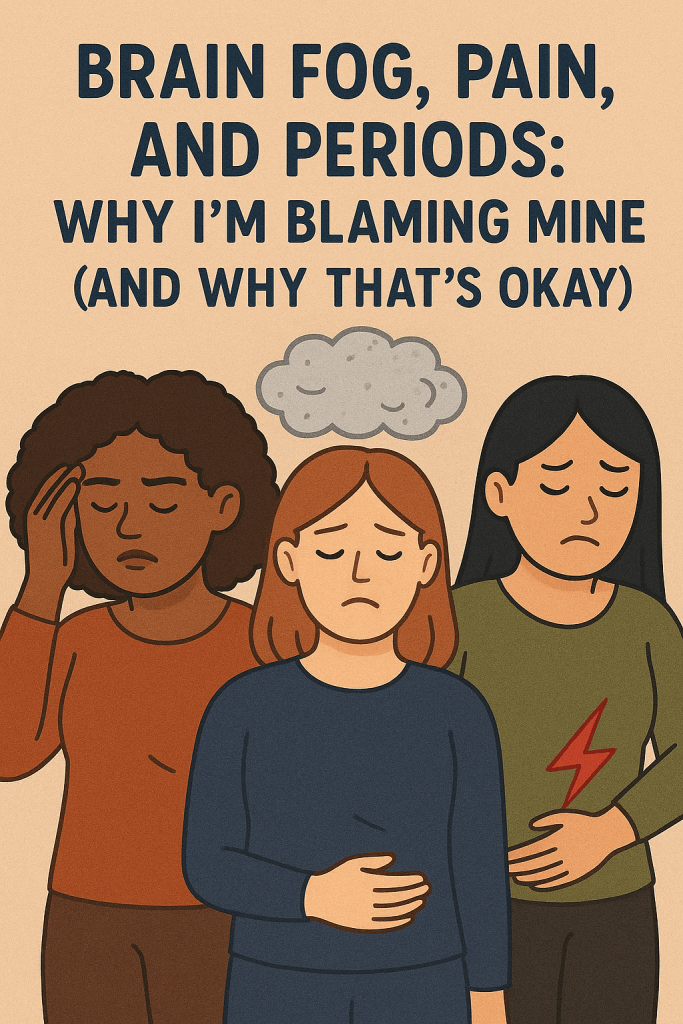
To be honest, I wanted to write a blog post today — something insightful, reflective, maybe even useful. But my mind has been foggy, and my body is just… off. And yes, I’m blaming my period. Even though I’m only three posts into this blog, I feel justified. Let me explain why.
Every month, like clockwork, I deal with the kind of period pain that derails everything. If I don’t take pain meds before the cramping starts, they don’t work. The worst of it usually lasts around 24 hours, and during that window, there’s very little that actually helps. Once, while working, the pain was so intense I threw up in the bathroom — and then went back to work, because what else could I do?
Any time I’ve brought this up with a doctor — primary care or OB/GYN — I’ve been brushed off. “Everything looks normal.” “It’s just your period.” “Some women just have it worse.”
Okay.
So life goes on. But it goes on with a lot of apprehension and tiredness. I’ve come to expect this routine. And while I don’t consider myself someone with chronic pain, I can absolutely empathize with those who live with pain every day — and still have to go about their lives.
Living With Pain — Even Temporarily — Changes Everything
According to the CDC’s National Center for Health Statistics, in 2023 about 24.3% of U.S. adults experienced chronic pain in the past three months, and 8.5% experienced high-impact chronic pain—meaning pain that frequently limits life or work activities (CDC).
It doesn’t matter how long someone has been in pain — the daily realities don’t get easier with time. For me, when my period hits, I often have to cancel anything outside of work or school. I rest, I curl up into a ball, I ride it out. And if there’s a silver lining, it’s this: these experiences force me to think about my future patients who are navigating pain — chronic or temporary — in their own lives.
- What do they have to give up because of their pain?
- How do they adjust their routines, their goals, their dreams?
- In what ways do they feel left out or misunderstood?
- Beyond pain medications, what actually helps?
- How can I, as a future physician, support them honestly and effectively?
Listening Is Part of the Medicine
It sucks to be in pain. It sucks even more when there’s no clear solution — or when people don’t believe you. I’ve felt that.
And so, through both my education and my lived experience, I hope to become one more doctor who listens. Who doesn’t dismiss or downplay. Who acknowledges that sometimes the best first step is saying: “I hear you. I believe you. Let’s figure this out together.”
For More on Chronic Pain Statistics
Check out the CDC’s NCHS Data Brief No. 518, Chronic Pain and High-impact Chronic Pain in U.S. Adults, 2023, for a detailed breakdown of these figures and how chronic pain varies across demographics and regions (CDC).
 🩺 Scrub In: The Motivated Med Life
Leave a comment